M4
M4
M4 Hybrid Aerial-Ground System
Role: Mechanical & Simulation Engineer
I contributed to the development of the M4 platform, a hybrid aerial-ground robotic system designed for both autonomous driving and vertical flight. My focus was on the mechanical, aerodynamic, and manufacturing integration that enabled the system’s dual-mode functionality.
Key Contributions:
Wheel Assembly & Chassis Architecture
Engineered the modular wheel assembly and lower chassis structure to support multi-modal operation, ground locomotion, manipulation, and airborne transition. Designed for stiffness, serviceability, and efficient load transfer during flight mode conversion.Advanced Manufacturing Pipeline
Led fabrication of high-performance components using high-temperature 3D printing (CF-PEEK, PA-CF), precision CNC machining, and composite post-processing workflows. Managed tolerancing, fit validation, and material conditioning to achieve aerospace-grade finish and dimensional accuracy.Simulation & Validation (ANSYS)
Conducted CFD and FEA simulations to analyze aerodynamic efficiency, thermal behavior, and structural integrity under realistic flight loads. Iteratively refined geometry to optimize lift, minimize drag, and ensure mechanical reliability.Empirical Thrust Verification
Calculated thrust output using ANSYS-derived models and validated results with RC Benchmark thrust stand testing. Established correlations between simulated and measured data to calibrate propulsion performance.
X1
X1
Robotic Synergy: Locking Mechanism & System Fusion
I engineered the mechanical locking interface that fuses the humanoid unit to the M4 (or “X1 system”) framework, enabling unified movement and coordinated control. I handled the design from concept through simulation, prototyping, and integration.
Scope & Contributions:
Concept & mechanical design: Mapped constraints (alignment tolerances, insertion forces, cycle life) and developed the interface geometry in CAD, with clear modularity and maintainability.
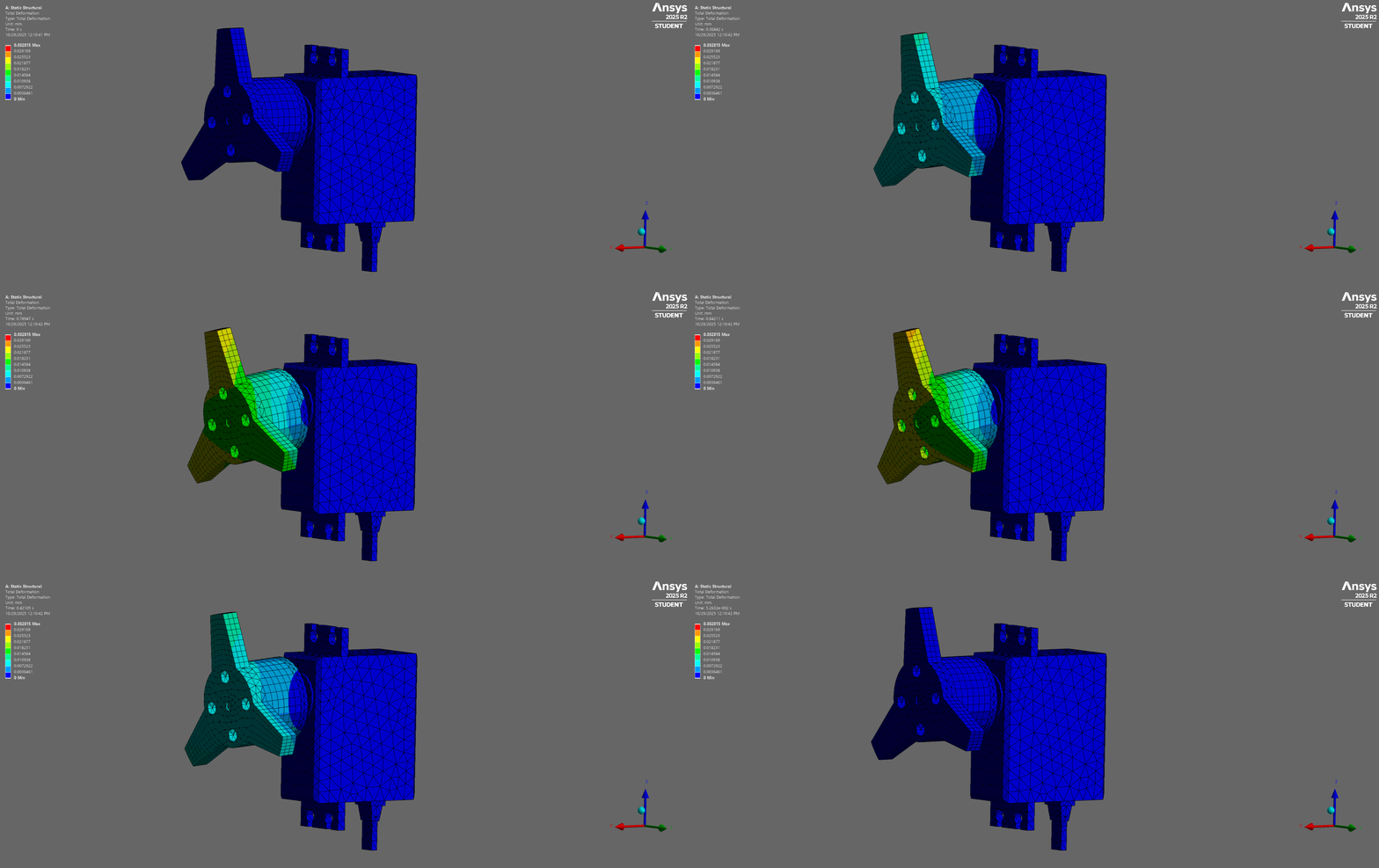
Simulation in ANSYS: Ran structural, fatigue, and dynamic analyses to verify the mechanism under real-world loading. Optimized features to eliminate weak points and guarantee performance.
3D prototyping and manufacturability: Produced test prints and functional prototypes, iterated interface clearances, material selections, and assembly strategy. Transitioned to production-ready hardware.
Integration & calibration: Ensured that the locking system synchronizes with both the humanoid’s kinematic behavior and the X1/M4 actuation/control logic. Validated system-level operation so the fusion behaves seamlessly.
Outcomes:
The mechanism became the core physical link between the humanoid and the system, maintaining precise alignment, no slop or backlash, and durability over repeated cycles.
It allowed for combined movement and control without decoupling, enabling the collaborative behaviors shown in the video.